Toulon shuttle vs the €2 public ferry: don’t pay £20 for a 20-minute crossing
The honest comparison your cruise line won’t give you — prices, tickets, the exact walk to the 8M pier, the timetable, how to beat the big-ship queues, and how to be sure you’re back on board in time.
Side by side
*Shuttle price is per person, usually round-trip, and varies by cruise line — some charge nearer £12, a few include it free, most sit around £15–20. Even at the low end it’s many times the €2 ferry. Confirm the exact figure in your daily programme.
The two options land you in the same part of Toulon. The difference is money, flexibility and the view: the ferry is a real harbour crossing past the naval base, comes and goes all day, and you’re never tied to a coach rotation.
Which one is actually right for you
This isn’t “ferry good, shuttle bad”. For most people the ferry is the obvious call, but there are a handful of genuine reasons to take the shuttle instead.
- you can manage a flat 10-minute walk to the pier;
- you want to come and go on your own schedule;
- you’d rather spend €4 than £15–20 each;
- you like the idea of crossing the bay by boat.
- walking to the pier is genuinely difficult;
- your all-aboard is so tight you can’t risk a timetable;
- it’s one of the rare days the maritime line is suspended;
- you simply want zero logistics and the price doesn’t matter.
How to take the 8M, step by step
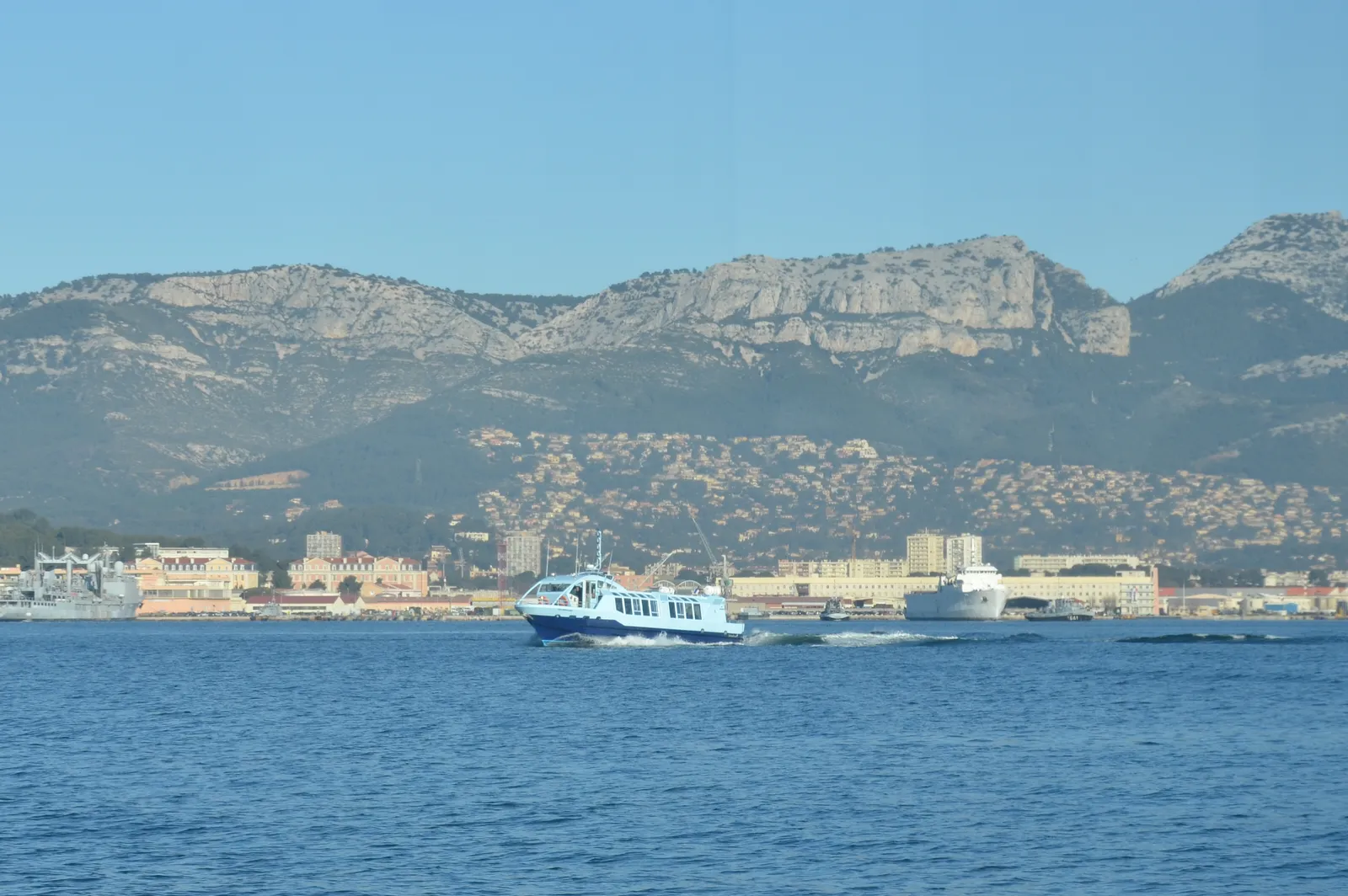
Tickets, payment & the Réseau Mistral app
The 8M is part of Réseau Mistral, the public transport network for the Toulon area — the same tickets work on its boats and buses. A single crossing is €2. You have three easy ways to pay:
- At the pier kiosk / machine — card or cash. This is the simplest for most people.
- In the Réseau Mistral app — buy on your phone before you board (handy if there’s a queue at the kiosk). Download it on the ship’s wifi before you leave.
- From the agent on the pontoon — when one is on duty, especially on busy cruise mornings.
Practical notes: it’s euros only — pounds and dollars aren’t accepted, and there’s no need to change money on board at a poor rate for a €4 day. Keep a couple of euro coins as a backup, and hang on to your ticket until you’re off the boat.
Timetable — and Sundays & holidays
The 8M runs all day, every day. Frequencies shift with the season and the day of the week, so treat the pattern below as a planning guide, not a fixed timetable — the exact next departure is always on the pier board and in the app.
Getting back to your ship on time
This is the only part that needs discipline. All-aboard is usually about 30 minutes before the ship’s departure — miss it and the ship leaves without you. The ferry is reliable, but the trick is to give yourself margin instead of catching the very last useful boat.
- Write down your all-aboard time from the daily programme before you leave the ship — not the departure time.
- Aim to be back on the Toulon quay ~90 minutes before all-aboard. That leaves you two or three ferry departures of slack, plus the 10-minute walk back to Môle Nord at the La Seyne end.
- Note the return times when you buy your outbound ticket, so a busy afternoon queue doesn’t catch you out.
- Taxi fallback: there’s a taxi rank on Quai Cronstadt in Toulon. A taxi around the head of the bay to Môle Nord is a 20–30 minute drive if you ever cut it fine — keep a note of a local taxi number.
- Worst case, the ship posts its local port agent’s phone number in the daily programme. If something goes truly wrong, call them — don’t just hope.
In practice, cross back mid-afternoon, keep an hour’s buffer, and you’ll never feel rushed.
Big-ship days: beating the queue
The 8M is a modest commuter boat, not a car ferry. On a normal call that’s no problem — but when a very large ship is in, several thousand guests can want the same crossing in the same two hours. The biggest callers at Môle Nord are Arvia (up to ~6,700 guests) and Costa Pacifica (up to ~3,800), and on their mornings the pier can back up between roughly 09:00 and 10:30.
Three ways to skip the crush:
- Go early — off the ship and across before ~08:45, ahead of the rush.
- Go late — let the wave clear and cross after ~10:30, when the pier is calm again.
- Go local first — spend the morning in La Seyne (the market, the pont levant, the parc de la Navale), then cross at midday when everyone else is coming back.
Accessibility & reduced mobility
The route is friendlier than it sounds: the quay at Môle Nord and the whole walk to the pier are flat and step-free, with no hills and no roads to cross, so it’s manageable with a stick, a slow pace or a pushchair. The pier and the boat are at water level.
The bateau-bus boards over a short ramp or gangway, and the exact step up or down depends on the tide and the boat; crew help passengers on and off. If you use a wheelchair or can’t stand for a wait, this is the one situation where the ship’s door-to-door shuttle can be the better choice — it drops you closer to the centre with no pier walk. If in doubt, ask your ship’s shore-excursions or accessibility desk how they’re handling the 8M on your call day.
“Is the shuttle really mandatory?”
Cruise lines sell the shuttle hard, and the wording in the daily programme can make it sound like the only way into town. On a normal alongside berth like Môle Nord, it isn’t. Foot passengers can walk out of the port gate on every call day and use public transport freely — the shuttle is a paid convenience, not a rule.
The genuine exceptions are rare and don’t apply here: a true tender port (where the ship anchors offshore and you can only reach land on the ship’s boats), or a working-port security escort. Toulon Bay cruise calls are alongside, so you simply walk off. If a crew member ever tells you that you can’t leave on foot, ask politely at guest services for the reason in writing — nine times out of ten it’s a sales line, not a restriction.