Toulon cruise port to Cassis and the Calanques, on your own
The most beautiful thing within reach of this port, and the one independent trip that genuinely works on a normal port day — if you know about the bus from the station and you go early.
Does it fit your port day?
This is the question every other guide skips. Here is the arithmetic on a typical call, for both of Toulon’s cruise quays.
- Time ashore, after clearance and all-aboard
- 10 hr 30 min
- − Ship to the station and back (about 1 hour 10 from the gangway)
- −2 hr 20 min
- − The train itself, both ways
- −1 hr 10 min
- − Safety margin we always keep
- −1 hr
- = Actually in Cassis
- 6 hr Doable
- Time ashore, after clearance and all-aboard
- 9 hr
- − Ship to the station and back (about 20 minutes from the gangway)
- −40 min
- − The train itself, both ways
- −1 hr 10 min
- − Safety margin we always keep
- −1 hr
- = Actually in Cassis
- 6 hr 10 min Doable
How we count: 30 minutes to actually get off the ship after the published arrival — nobody walks down the gangway at the stroke of the ETA — then all-aboard 30 minutes before the published departure, and a further 60 minutes kept in hand because a missed train doesn’t care that your ship is leaving. The Môle Nord figure includes the walk to the pier and an average wait for the 8M ferry: the leg every other guide forgets. Typical windows exclude turnaround calls, when guests are embarking rather than sightseeing. Your own ship’s hours are on the 2026 schedule; run the same subtraction with them.
How to get there, step by step
The station trap
Cassis station is not in Cassis. It stands about three kilometres inland and uphill from the harbour, among the vineyards, and the walk down is long, hot in summer and largely without pavement in places. The walk back up, with a train to catch, is worse.
The answer is the M1 “Marcouline” shuttle, which meets trains outside the station and runs down to the town roughly every 15 to 30 minutes, seven days a week, with a longer evening service in summer. It takes about a quarter of an hour. Buy from the driver.
The Calanques by boat
The calanques are limestone inlets — fjords cut in white rock, filled with water that turns an improbable green where it shallows. They run for twenty kilometres between Cassis and Marseille inside a national park, and the great majority of them can only be reached on foot or by sea.
From the quay at Cassis, the bateliers cassidains run sightseeing circuits all day. You choose by how many inlets you want: the short circuits take in the first three — Port-Miou, Port-Pin and the spectacular En-Vau — while the longer ones continue west towards Marseille and take a couple of hours. Tickets are sold from the kiosks on the quay, typically about half an hour before each departure, and the boards show the day’s times.
Two honest warnings. First, the standard circuits do not land and do not stop to swim — they are a sightseeing cruise, not a beach trip; ask at the kiosk if you want one of the rarer excursions that does. Second, they are entirely at the mercy of the weather: in a strong mistral the boats simply do not sail, and you will find the kiosks shut. That risk is the single best argument for booking a tour with a guaranteed alternative if the calanques are the reason you came.
Or walk them instead — free
You can reach the first calanques on foot from the town, which costs nothing and does not depend on a boatman’s weather call. From the harbour it is roughly half an hour on the waymarked path to Port-Miou, a long narrow inlet full of moored boats, and about fifteen minutes further to Port-Pin, which has a small pebble beach and pines down to the water — a genuine swimming spot.
En-Vau, the famous one, is another hour beyond that over rough ground with a steep descent, and it is not a sensible objective on a port day. Wear real shoes, take water, and be aware that in high summer the national park closes paths outright on days of severe fire risk — the restriction is published each morning. If the paths are shut and the sea is rough, Cassis itself is still worth the journey.
Cassis itself
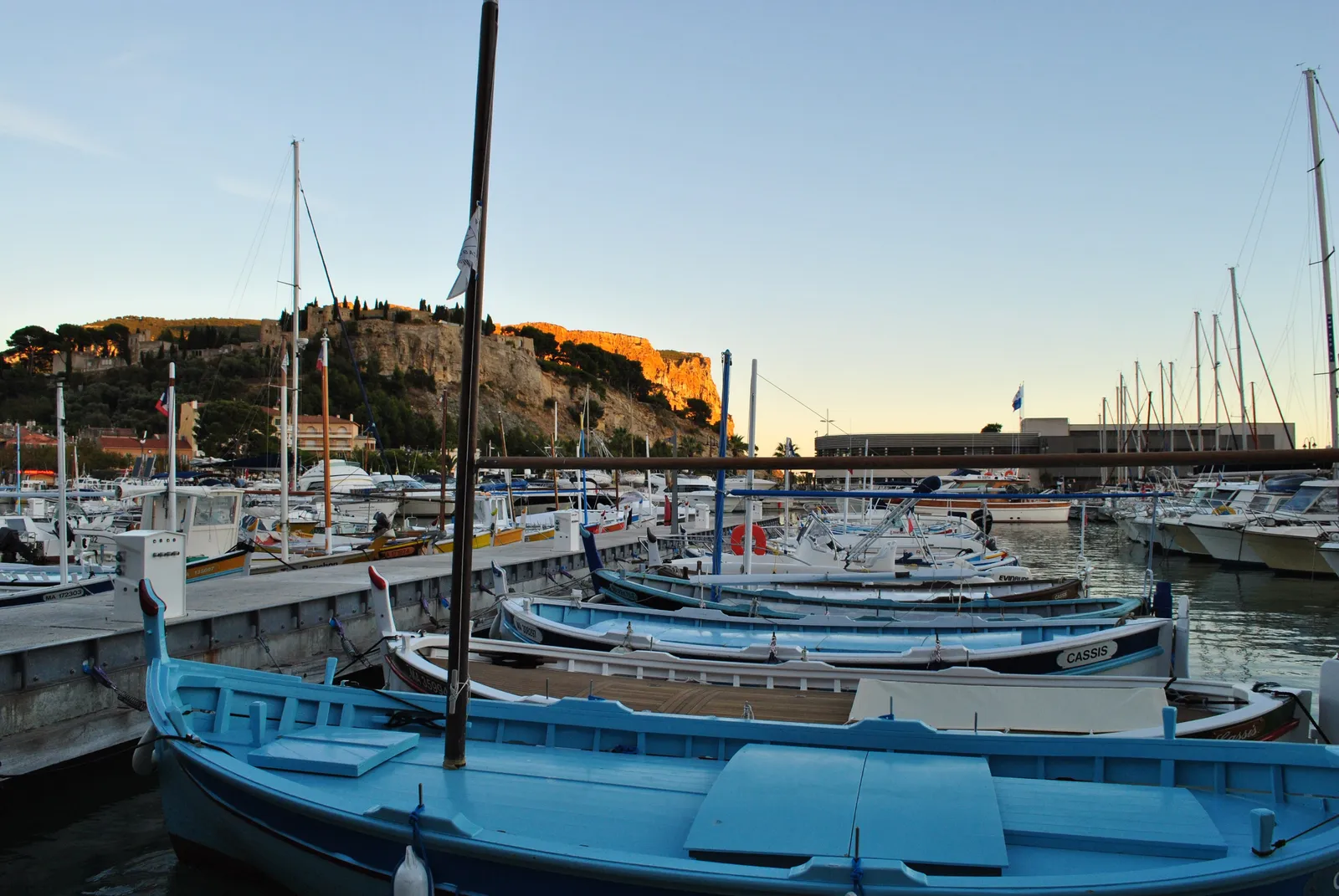
Even without the boat, this is a good place to spend an afternoon. A small ochre-and-pastel harbour, fishing boats among the yachts, a line of cafés along the quay, a beach at each end of the town, and behind it all the Cap Canaille — at nearly 400 metres, one of the highest sea cliffs in France, going red at the end of the day.
Cassis also has its own small wine appellation, mostly white, made on the terraces between the town and the hills; you will see it on every menu on the quay and it is genuinely good with the local fish. Prices on the front are what you would expect of a beautiful harbour in high season — a street back, they are ordinary.
Getting back on time
You are relying on four links — the M1 bus, the TER, the 8M ferry and your own legs — and only the last is under your control. That is fine, provided you build the margin in at the start rather than hoping at the end.
- Write down your all-aboard time before you leave the ship — not the departure time. They are usually 30 minutes apart.
- Plan on the train before the one that works. If the maths says the 16:12 gets you home, take the 15:12. Regional trains are usually punctual, but there is no second chance.
- Photograph the M1 return timetable when you arrive, and set an alarm for the departure you have chosen.
- Remember the ferry at the far end. If your ship is at Môle Nord, arriving at Toulon station is not the same as being back — you still have the walk down and a crossing to catch.
- Keep the port agent’s number, printed in your daily programme, in your phone. If a train is cancelled, call early rather than late.
Or let someone else handle it
A booked tour picks you up near the port, removes the four-link chain above, and — if it is the ship’s own — obliges the vessel to wait for you. Worth it if your call is short, if you are at Môle Nord with a 16:00 departure, or if the boat trip is the whole point and you would rather not risk the mistral.